

Overview
Innomesh Room Manager integrates with Infoblox DDI (DNS, DHCP, and IPAM) systems to automatically reserve IP addresses for devices during room deployment while maintaining synchronisation with Infoblox records. This integration reduces manual network configuration, eliminates IP conflicts, and ensures that device network details in Innomesh always reflect the authoritative IPAM source.
IPAM Administration
Subnet Groups
Subnet Groups organise subnets for automatic IP assignment. Each group can be configured for standard (unicast) or multicast addresses, allowing Innomesh to allocate from the correct address range based on device requirements.
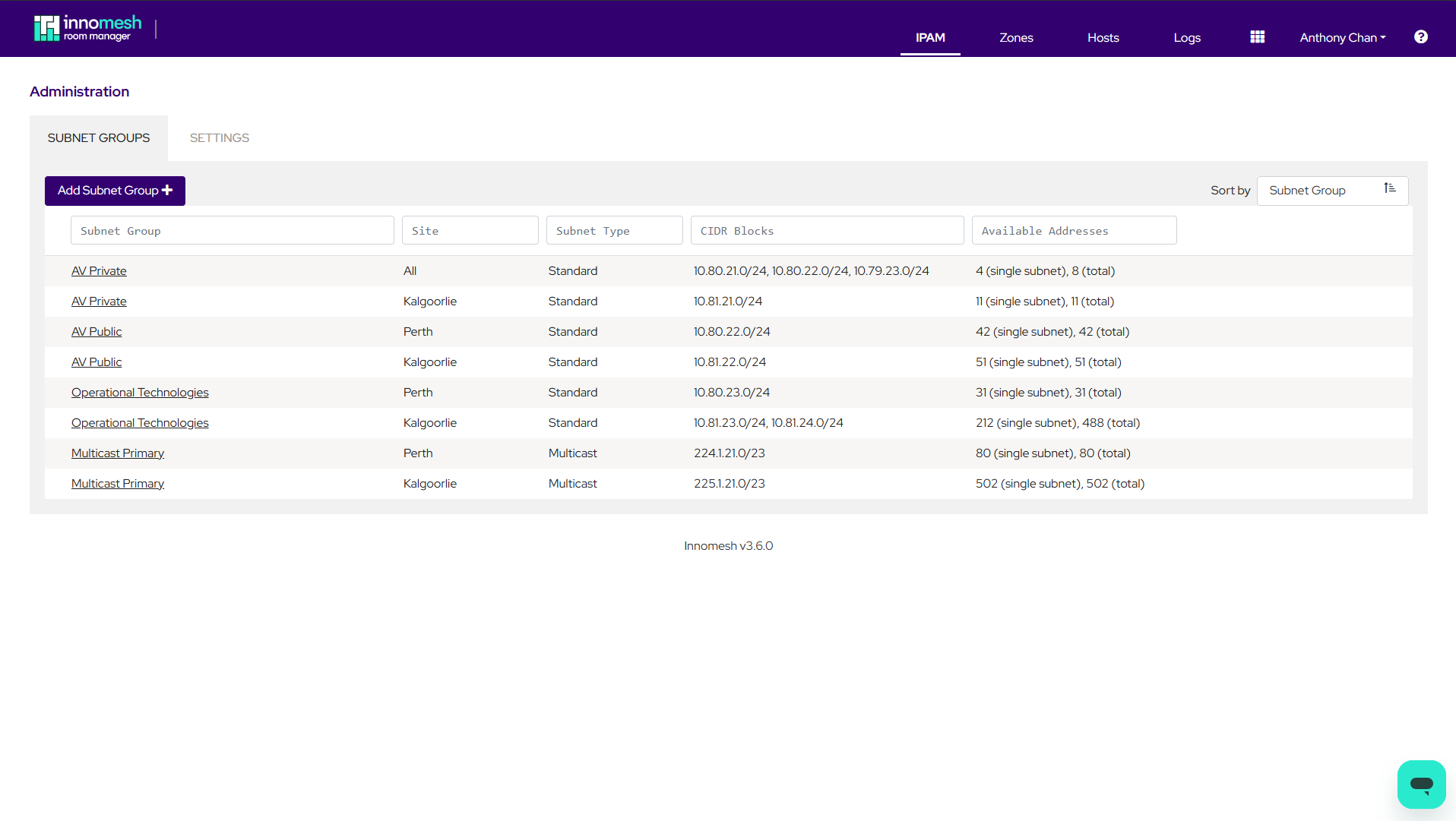
The Subnet Groups tab is a searchable, sortable, exportable table:
| Column | Description |
|---|---|
| Subnet Group | The name of the subnet group. Click to edit. |
| Site | The Site this subnet group is available to. “All” means it can be used in any room. |
| Subnet Type | Either Standard (unicast IP addresses) or Multicast. |
| CIDR Blocks | Subnets assigned to this group in CIDR notation (e.g. 10.80.21.0/24). |
| Available Addresses | Most available in any single subnet / total available across all subnets. Refreshed on page load. |
Creating a Subnet Group
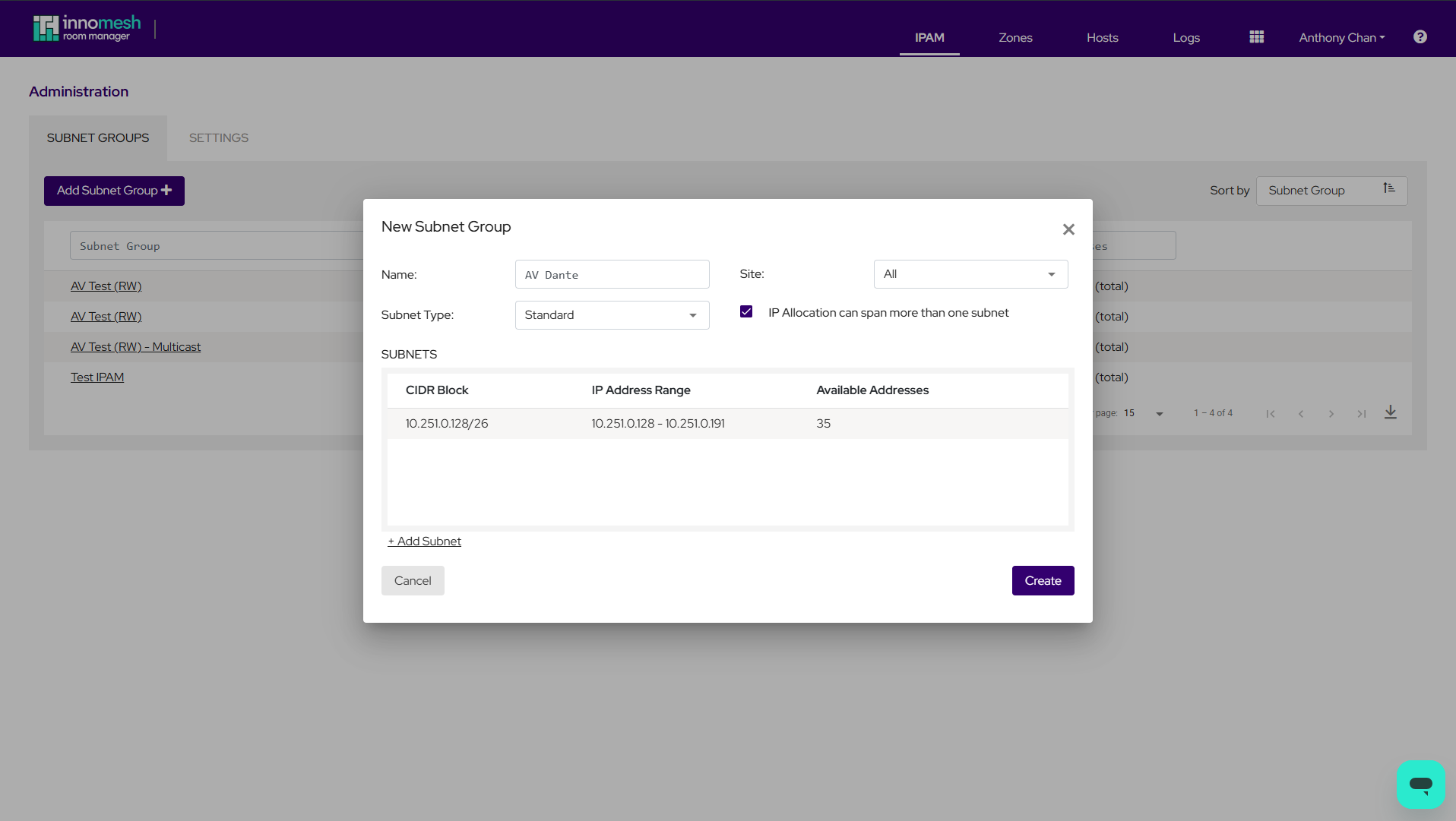
- Click New Subnet Group.
- Enter a Name for the subnet group.
- Select a Site from the dropdown. Choose “All” to make it available at any Site.
- Select the Subnet Type: Standard or Multicast.
- Optionally tick IP allocation can span more than one subnet. When enabled, a deployment may draw IPs from multiple subnets if a single subnet lacks sufficient addresses.
- Click Add Subnet and enter a CIDR block. Innomesh validates each subnet against Infoblox; subnets not present in Infoblox are flagged as invalid.
- Add additional subnets as needed, then click Create.
Editing and Deleting
Click the subnet group name or press Edit. The Name, Site, and Subnet Type are read-only after creation. You can modify the spanning setting and add, edit, or remove subnets.
Press Delete to open a confirmation modal.
Settings
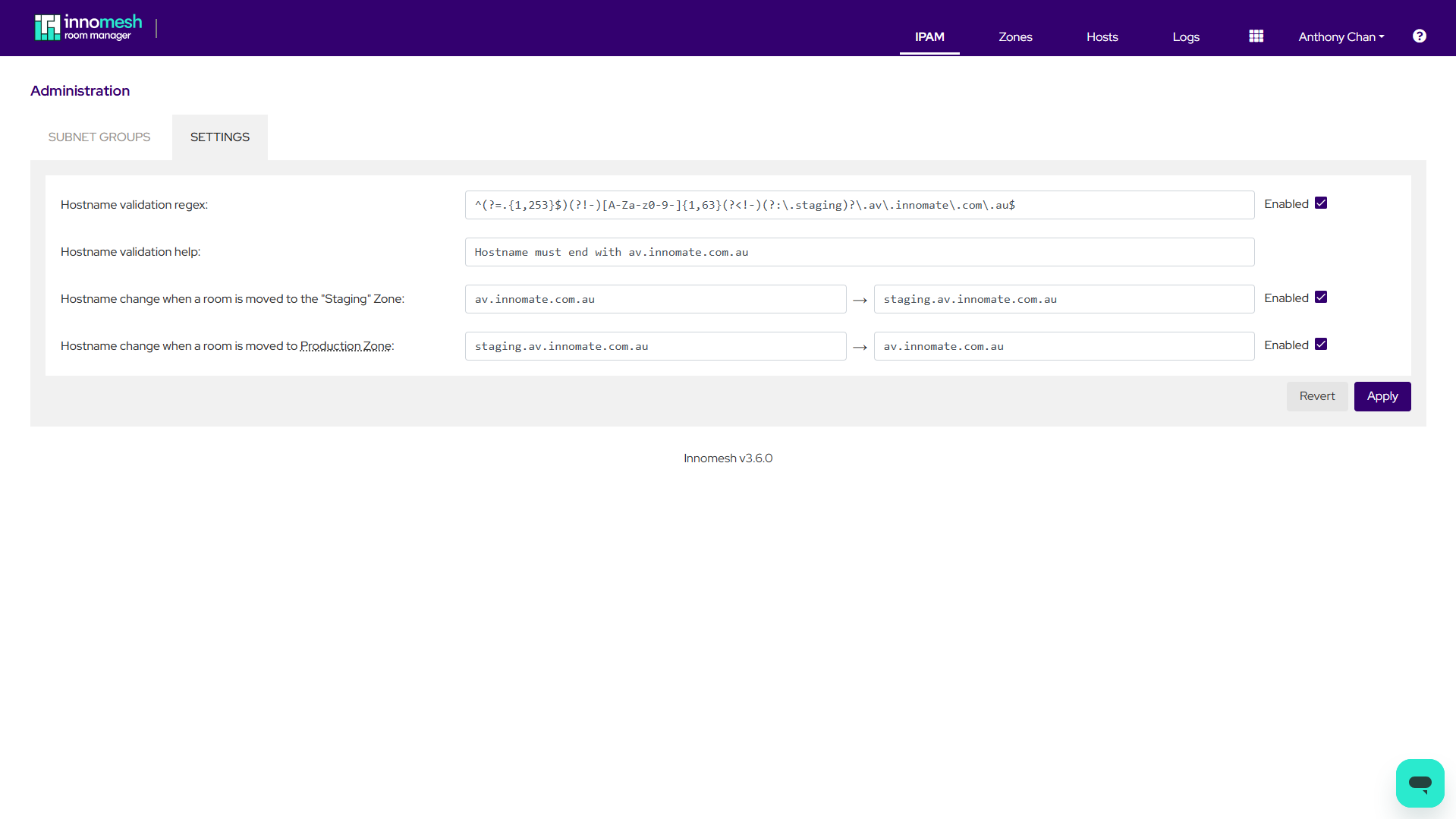
The IPAM Settings page configures global hostname validation and automatic hostname modification behaviours.
| Setting | Description |
|---|---|
| Hostname validation regex | A regular expression all device hostnames must match (e.g. hostnames must end with .av.example.edu.au). |
| Hostname validation help | Custom tooltip text displayed when a hostname fails validation. |
| Staging hostname modification | Find-and-replace rules applied when a room moves into the Staging Zone (e.g. av.example.edu.au → staging.av.example.edu.au). |
| Production hostname modification | Find-and-replace rules applied when a room moves from Staging to a production Zone (typically the reverse of staging). |
Each feature can be individually enabled or disabled via its checkbox. Disabled features clear their fields. Press Apply to save, or Revert to undo unsaved changes.
Device Configuration
Auto IP Toggle
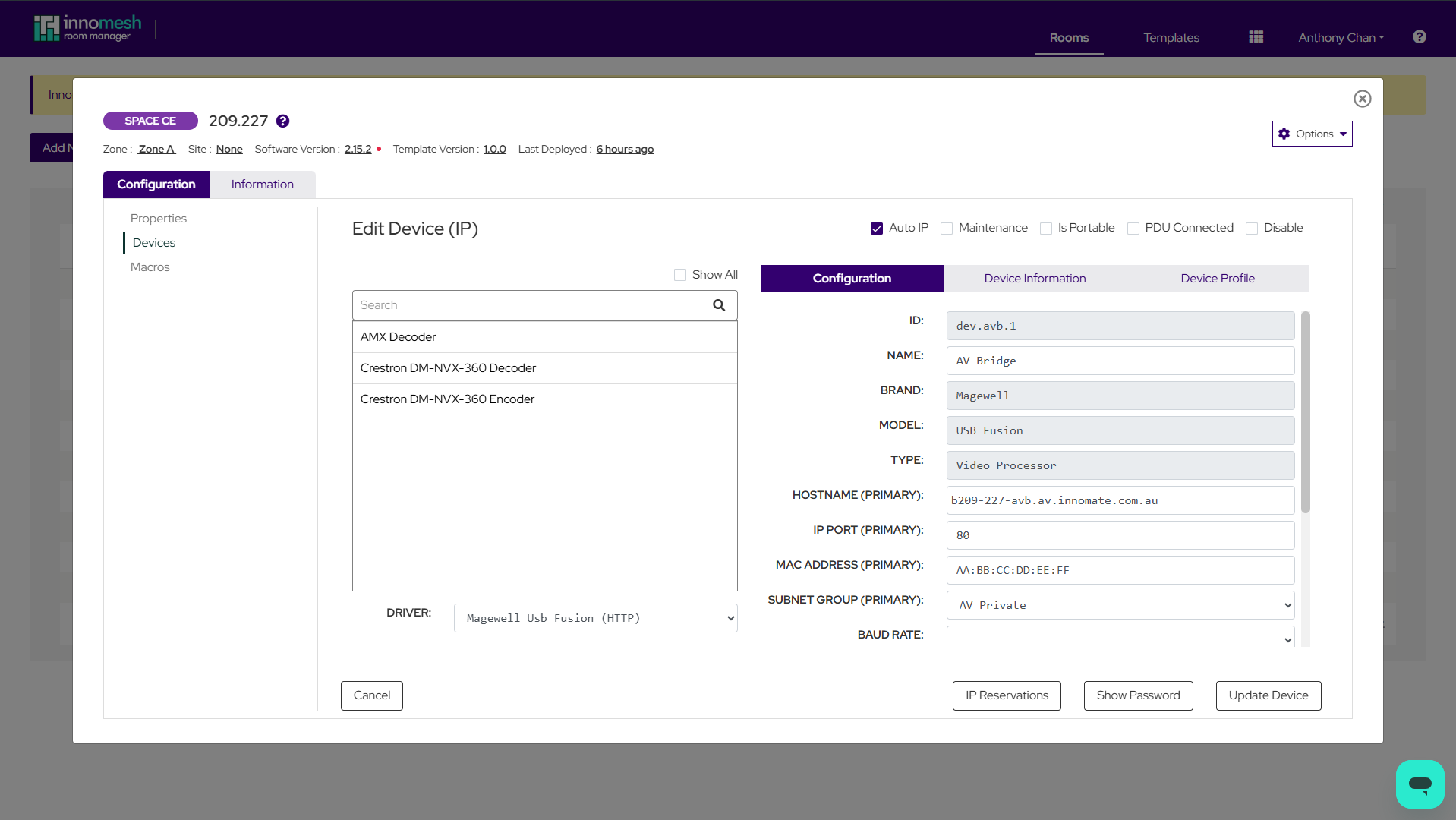
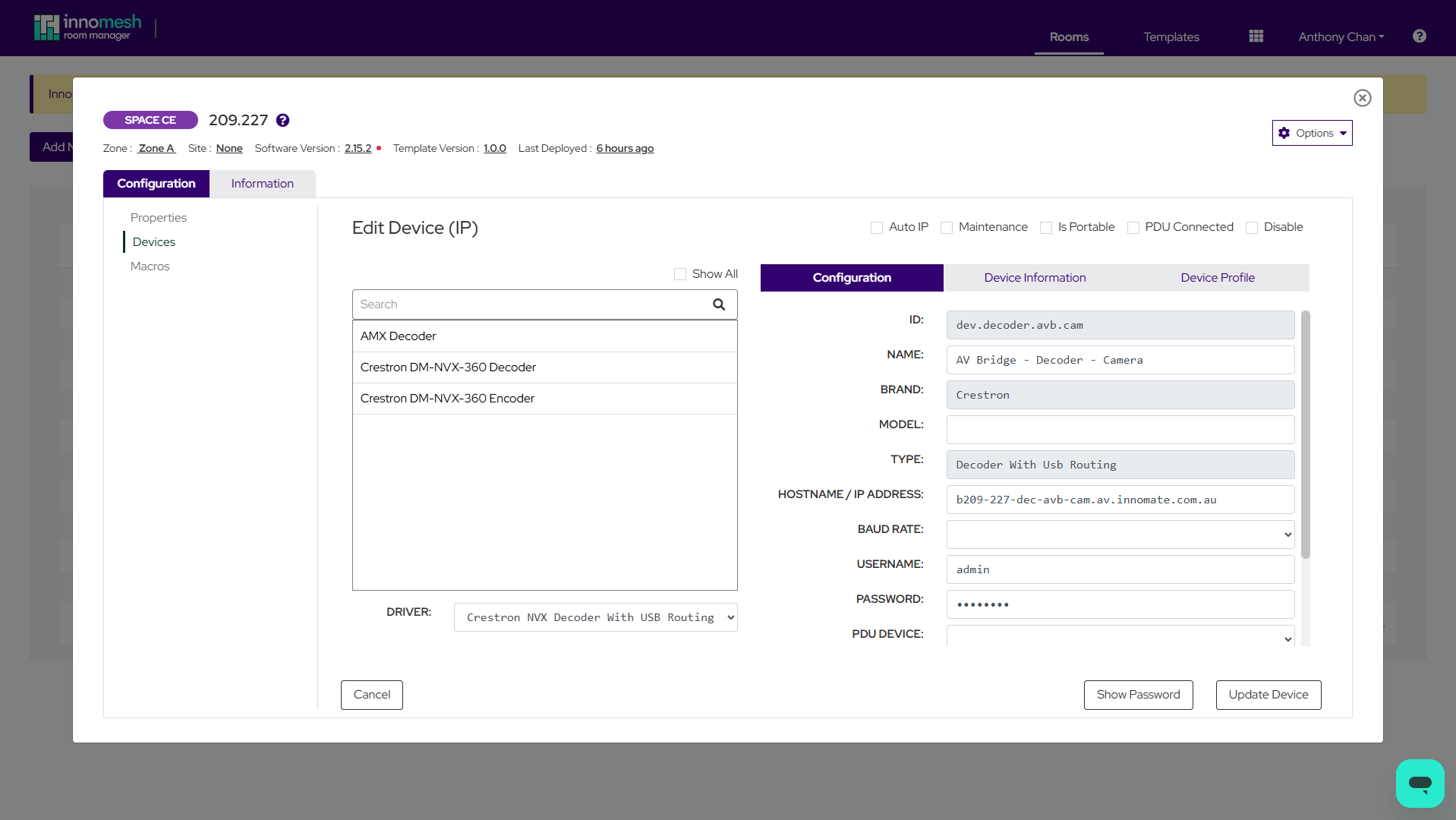
Each device in Room Manager includes an Auto IP toggle that enables or disables automatic IP reservation from Infoblox.
- Auto IP enabled: A valid MAC address and hostname are required (IP addresses are not accepted). A Subnet Group must be selected. Innomesh reserves a free IP from the selected Subnet Group at deployment time.
- Auto IP disabled: A hostname or IP address is accepted. No automatic reservation occurs. The value is treated as a static entry.
New devices have Auto IP enabled by default. The ability to toggle Auto IP may be restricted by the Toggle device Auto IP settings permission; without it, the checkbox appears read-only.
Multiple Network Interfaces
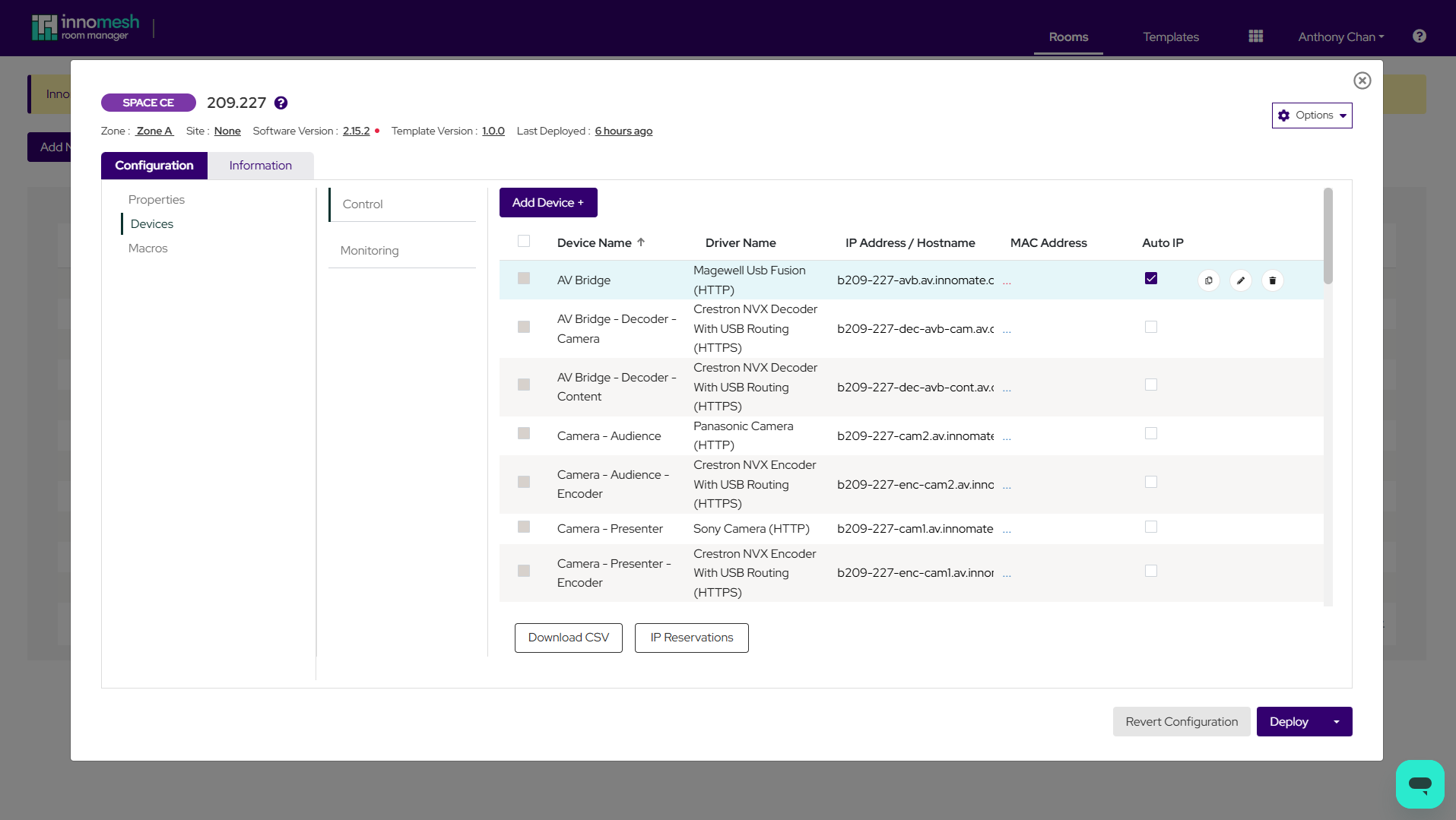
Devices with multiple network interfaces are supported. Each interface can have its own IP reservation, and Innomesh manages all reservations during the deployment process.
IP Reservations
Standard Reservations
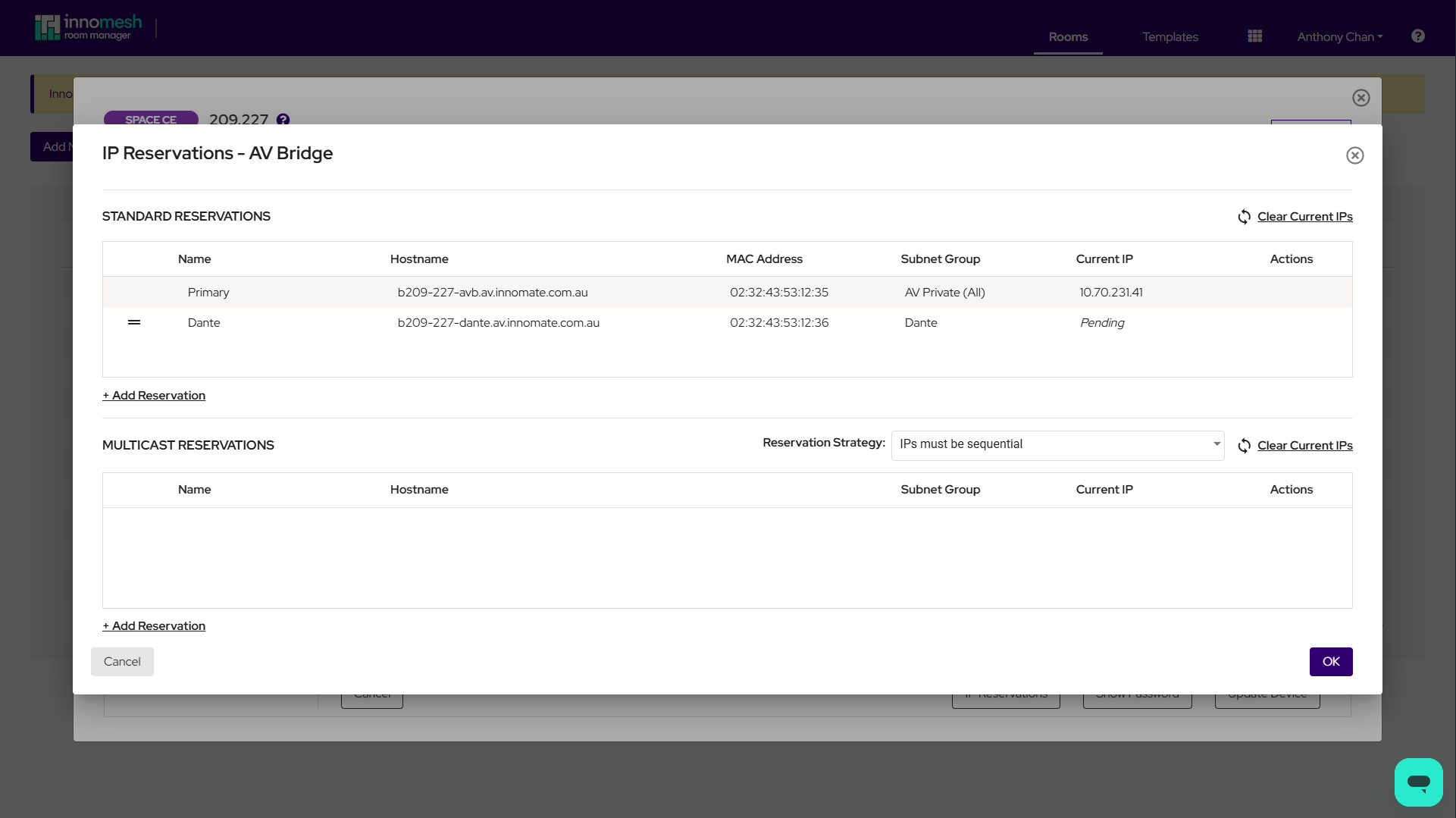
When Auto IP is enabled, a reservations modal allows configuration of IP reservations for the device. Every device requires at least one Primary reservation. Additional reservations can be added for secondary interfaces.
Multicast Reservations
Multicast reservations are used for devices that require multicast IP addresses (e.g. video and audio streams). The hostname for each multicast reservation is read-only and automatically synchronised from the Primary standard reservation. Only Multicast-type Subnet Groups are available for selection.
Reservation Strategy
Multicast reservations support a configurable allocation strategy:
| Strategy | Behaviour |
|---|---|
| IPs may be non-sequential | Addresses are allocated from any available position in the subnet. |
| IPs must be sequential | Addresses are allocated as a contiguous block. |
| Sequential, starting with an odd last octet | Contiguous block where the first address has an odd last octet (e.g. x.x.x.53, x.x.x.54). |
| Sequential, starting with an even last octet | Contiguous block where the first address has an even last octet (e.g. x.x.x.6, x.x.x.7). |
Extensible Attributes
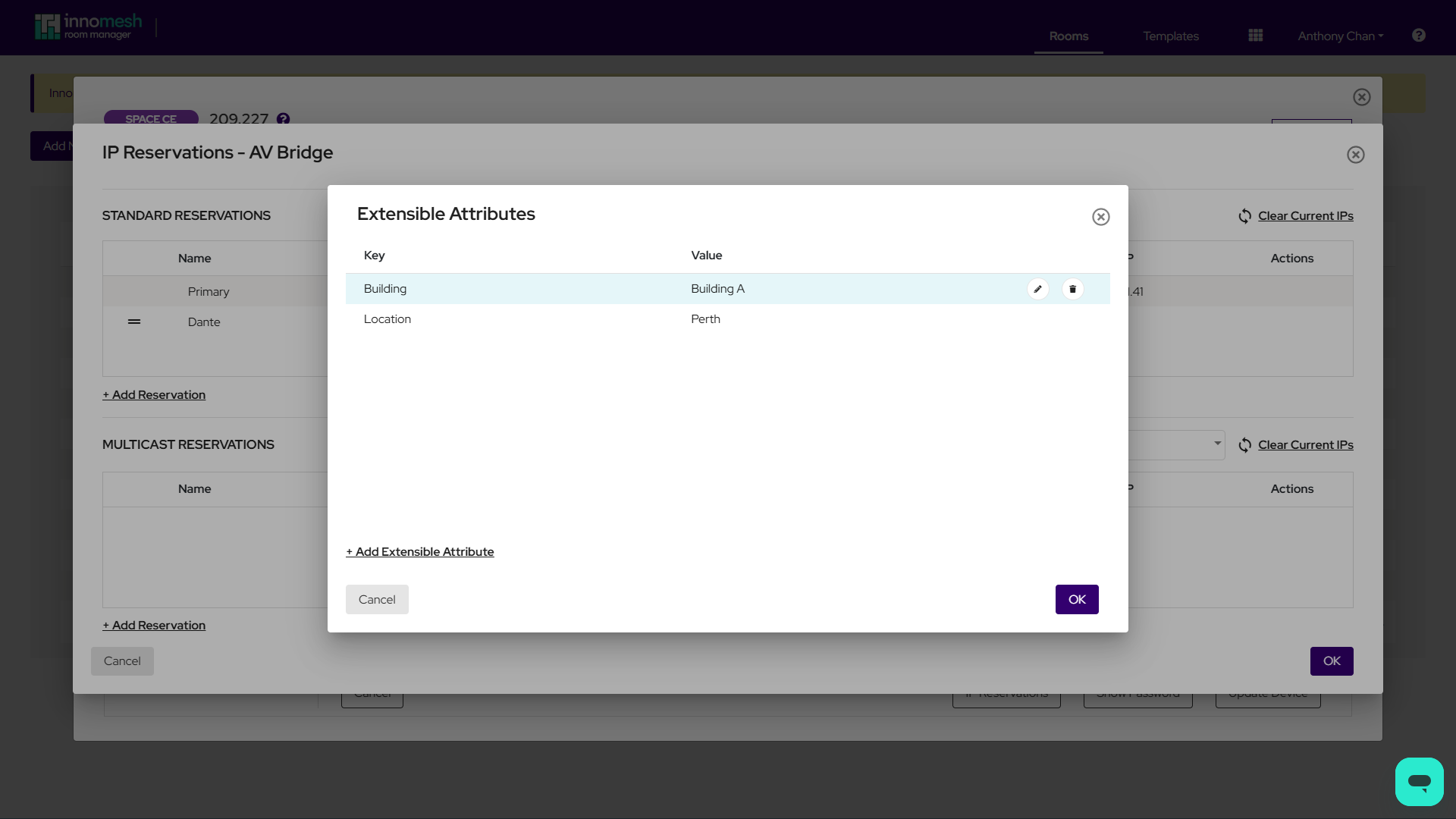
Each reservation row includes an Extensible Attributes button that opens a modal for managing key-value pairs pushed to Infoblox.
- Key: Selected from a dropdown of available EAs defined in Infoblox.
- Value: Input type depends on the EA type — free text for String/URL/Email, numeric input for Integer, date picker for Date, or a dropdown for Enum. Enum types include a Custom option that converts the dropdown into a free-text field, useful for dynamic expressions.
- Some EAs may be configured by Innomate as hidden (not displayed) or read-only (displayed but not editable).
- For standard reservations, EAs are shared across all reservations with the same hostname, even across different devices.
Room IP Reservations View
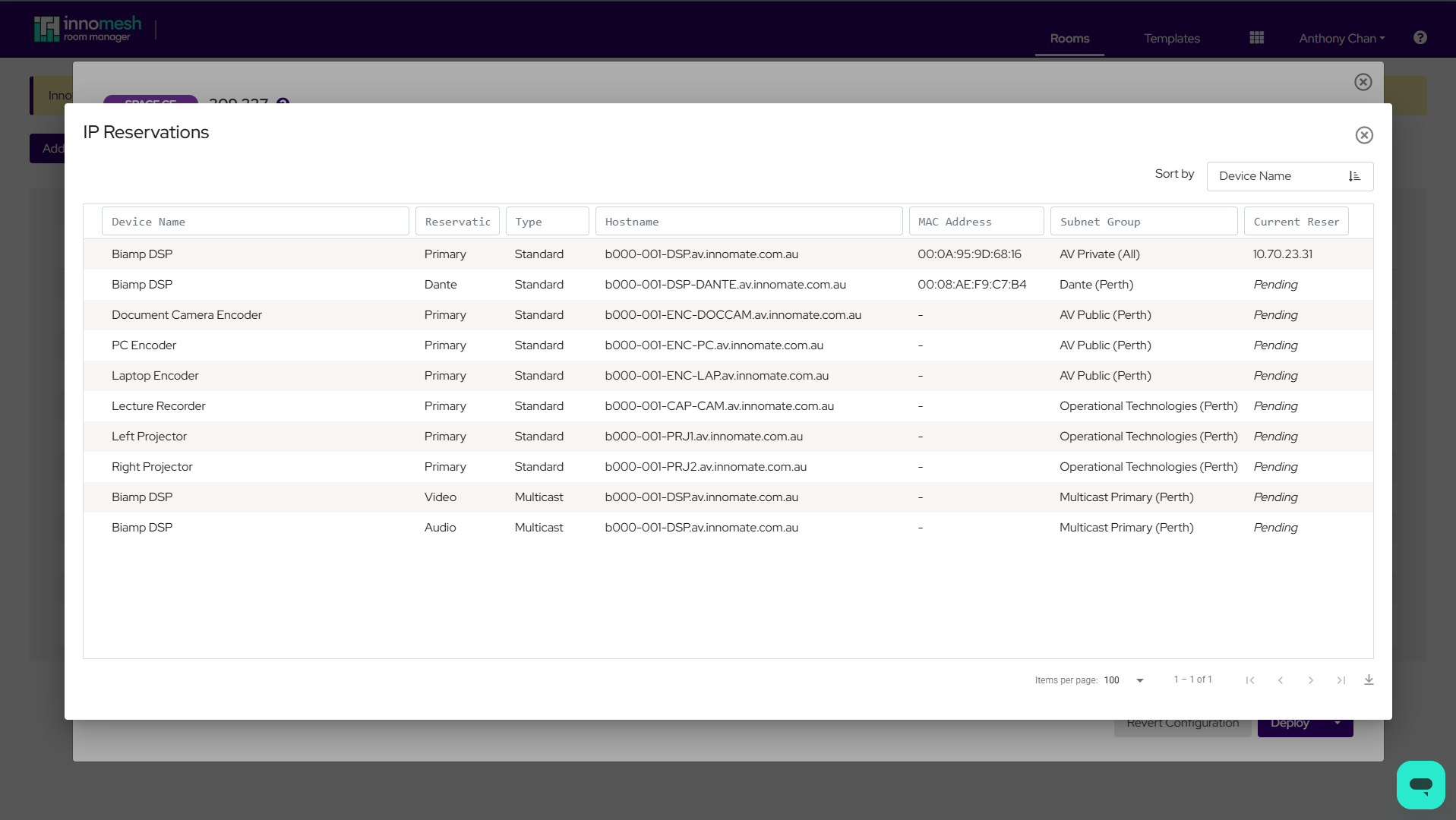
The room-level View IP Reservations button on the room configuration page opens a consolidated, read-only table of all standard and multicast reservations for the room.
Columns: Device Name, Reservation Name, MAC Address, Hostname, Subnet Group, Current Reservation.
Hover over a reservation to see additional detail: Netmask, Gateway, and any Extensible Attributes.
Export the table as CSV to receive additional columns for Netmask, Gateway, and one column per Extensible Attribute in use across the room’s reservations.
Site and Zone Behaviour
Changing a Site
When a room’s Site is changed, Innomesh reassigns device Subnet Groups to match the new Site in the following priority order:
- A Subnet Group with the same name at the new Site.
- A Subnet Group with the same name with Site set to “All”.
- If neither is found, the Subnet Group for that device is cleared.
Any current IP addresses that fall outside the new Subnet Group’s range are reset to Pending.
Moving Between Zones
When a room moves between Zones, Innomesh can automatically modify device hostnames according to the rules configured in IPAM Settings:
| Target Zone | Behaviour |
|---|---|
| Staging | Hostnames are modified according to the staging find/replace rules (e.g. av.example.edu.au → staging.av.example.edu.au). |
| Production (any zone other than Staging or Parking Lot) | The production find/replace rules are applied, typically reversing the staging changes. |
| Parking Lot | No hostname changes are made. |
Hostname modifications apply to all reservations (standard and multicast) across every device in the room.
Deployment Process
Creating or Updating a Room
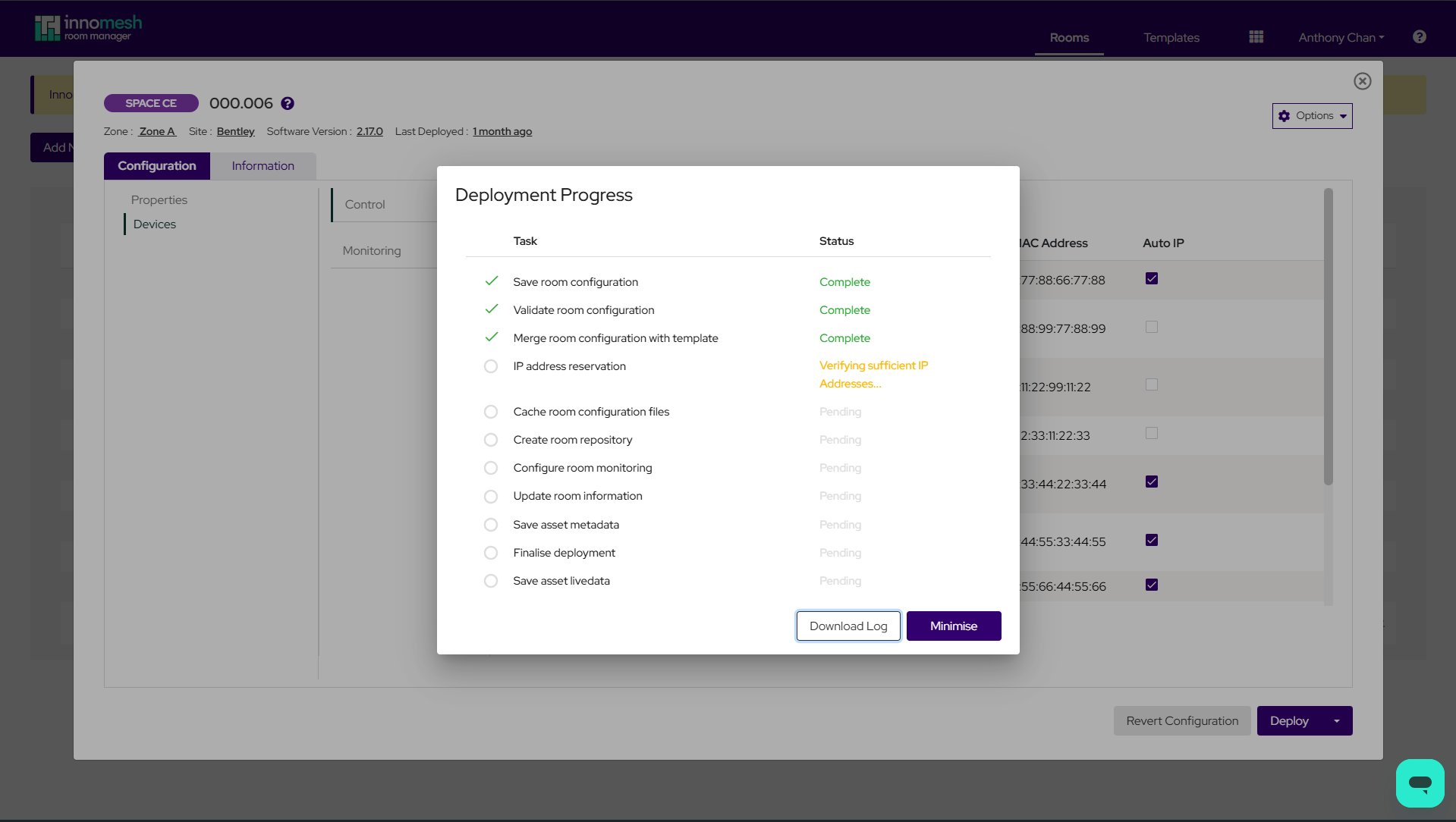
When a room with Auto IP-enabled devices is deployed, Innomesh performs the following steps:
- Validate: Hostname formats, MAC addresses, Subnet Group assignments, and device IDs are checked.
- Check availability: Sufficient free IP addresses are confirmed for all requested Subnet Groups.
- Adopt existing records: If an Infoblox host record already exists for a matching hostname and MAC, Innomesh adopts it by tagging it with Innomesh metadata.
- Remove unused records: Records for devices that have been removed from the room configuration are deleted from Infoblox.
- Update existing records: Records are updated as needed to reflect changes to hostnames, MAC addresses, IPs, or Extensible Attributes.
- Create new records: New Infoblox records are created for new devices and reservations.
- Restart DNS/DHCP services: Infoblox grid services are restarted to apply changes.
- Save reservation data: The reservation list is stored for future reference.
Deleting a Room
When a room is deleted:
- All Innomesh-managed Infoblox records for the room are removed.
- DNS/DHCP services are restarted.
- The reservation list is removed.
Templates
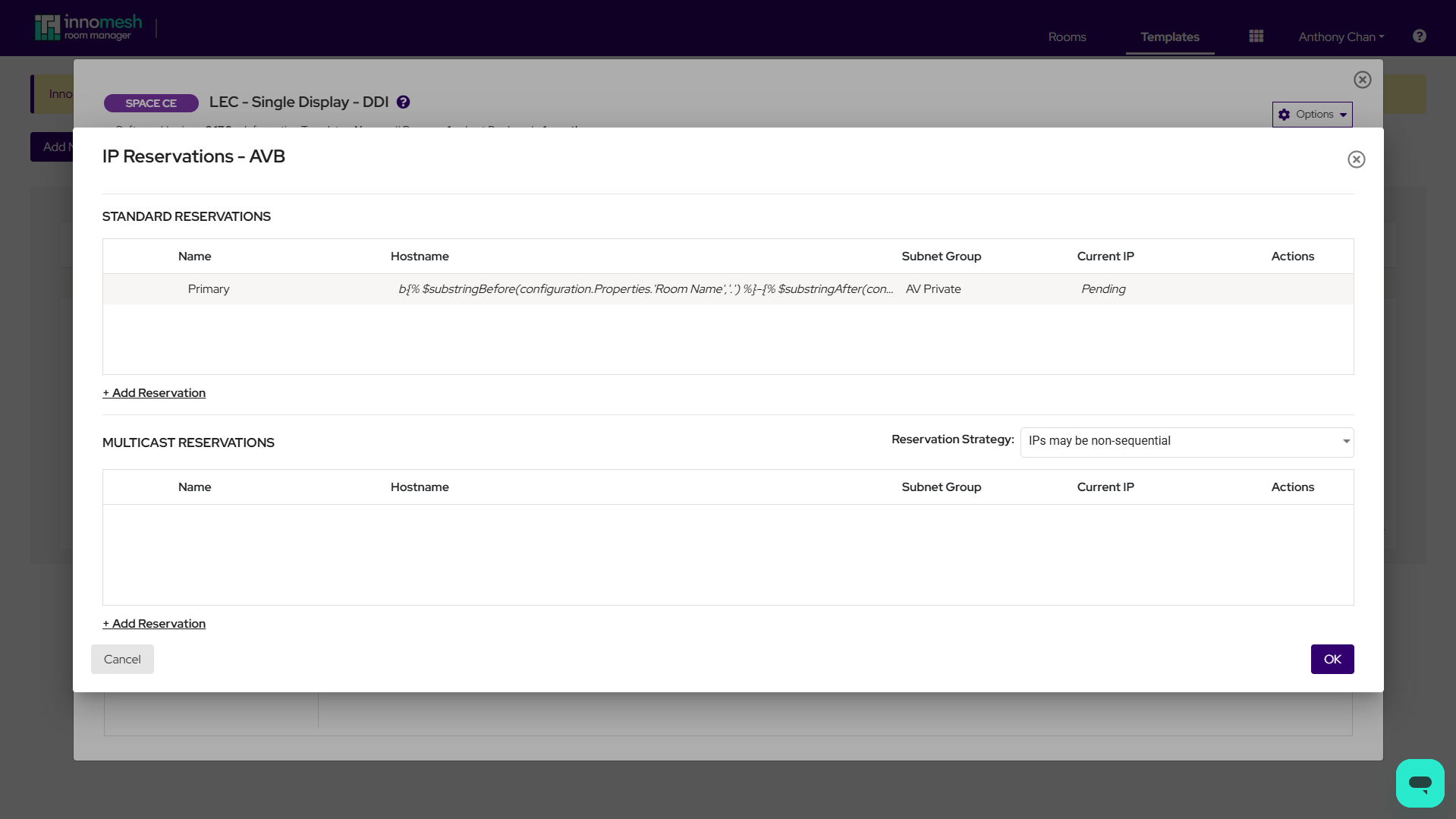
IP reservations can be pre-configured at the template level, so rooms created from the template inherit the reservation settings automatically.
Template IP reservation configuration is identical to room-level configuration, with these differences:
- MAC Address is not available (it is room-specific).
- All Current Reservation values are shown as Pending.
- All Subnet Groups are selectable, regardless of Site.
- The Clear Current IPs button is not shown.
When a room is created from a template, reservation settings (including Extensible Attributes) are inherited. Changes made to a template do not retroactively affect existing rooms.
Dynamic Expressions
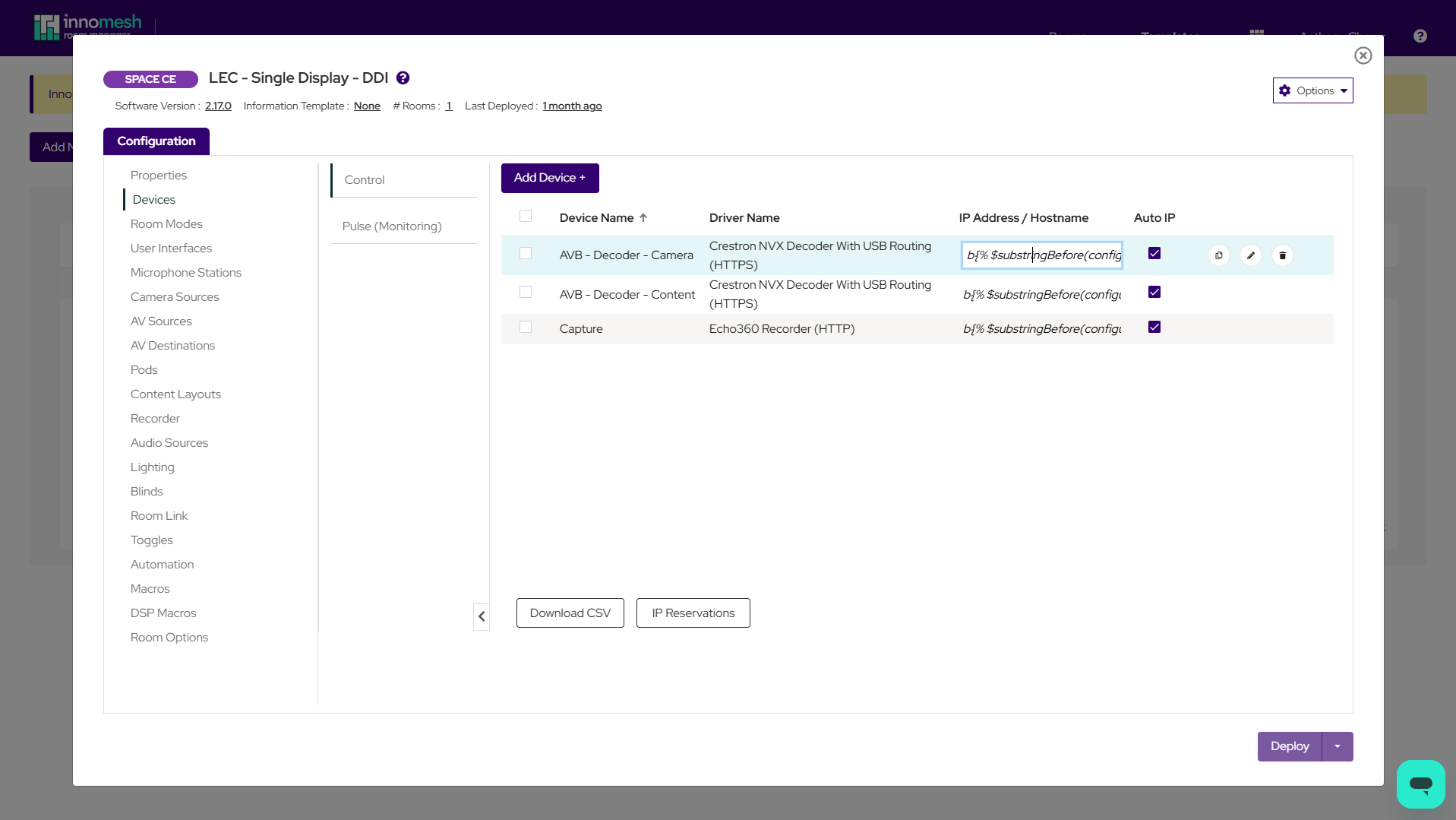
Both room and template configurations support dynamic expressions for values that should be computed from other parts of the configuration. Expressions are enclosed in {% %} braces and resolved at deployment time.
For example, a template hostname pattern:
dsp1-{% $lowercase(configuration.Properties.`Room Name`) %}.av.example.edu.auFor a room with Room Name “GP-A123”, this resolves to dsp1-gp-a123.av.example.edu.au.
Key behaviours:
- Fields using dynamic expressions appear in italics.
- Hovering over these fields shows a tooltip with the dynamic expression.
- Updating a referenced field (e.g. Room Name) automatically updates all expressions that reference it.
- Expressions can be used in hostnames and Extensible Attribute values.
Usage tips:
- Dynamic expressions use JSONata notation.
- References to the main Space CE/VC configuration start with
configuration.(e.g.configuration.Properties.`Room Name`). - References to the monitoring configuration start with
monitoring.(e.g.monitoring.room_name). - Download the room JSON from the Options menu to inspect available fields.
Access Control
The following RBAC permissions govern DDI features:
| Permission | Scope |
|---|---|
| IPAM: Manage Subnet Groups | Create, edit, and delete Subnet Groups under Administration → IPAM. |
| IPAM: Manage Settings | Configure IPAM settings (hostname validation, staging/production hostname rules). |
| Toggle device Auto IP settings | Enable or disable Auto IP per device. Without this permission, Auto IP checkboxes are read-only. |
Standard room permissions (view, edit, deploy) continue to apply. Users can deploy rooms with IP reservations as long as they have the appropriate room-level permissions.