

This guide walks through creating a Pulse template in Innomesh Room Manager. A template is a reusable blueprint from which standardised rooms are created, so a common room type only has to be defined once. A Pulse template defines the set of devices to monitor in that room type and, for each device, the connection protocol (ICMP, TCP, or HTTP) and settings Pulse uses to track its reachability and health. When you create a room from the template, you keep this device set and adjust the room-specific details, such as the room name and each device’s IP address or hostname.
Like Sight, Pulse templates and rooms are loosely associated: once a room is created, the template can be updated without affecting that room, and template changes cannot be pushed back to existing rooms. Pulse also has no user-selected software version; the Pulse software is abstracted from the user and kept up to date by Innomate as part of the Innomesh SaaS platform. See Templates & Rooms for how templates and rooms relate across the subscription tiers.
Step 1: Navigate to the Templates Page
Click the Templates button in the top-right corner of the Innomesh interface to open the Templates page.
Step 2: Add a New Template
Click the Add New Template button. A popup window appears prompting you to select the system template type. Choose Pulse, then click Next.
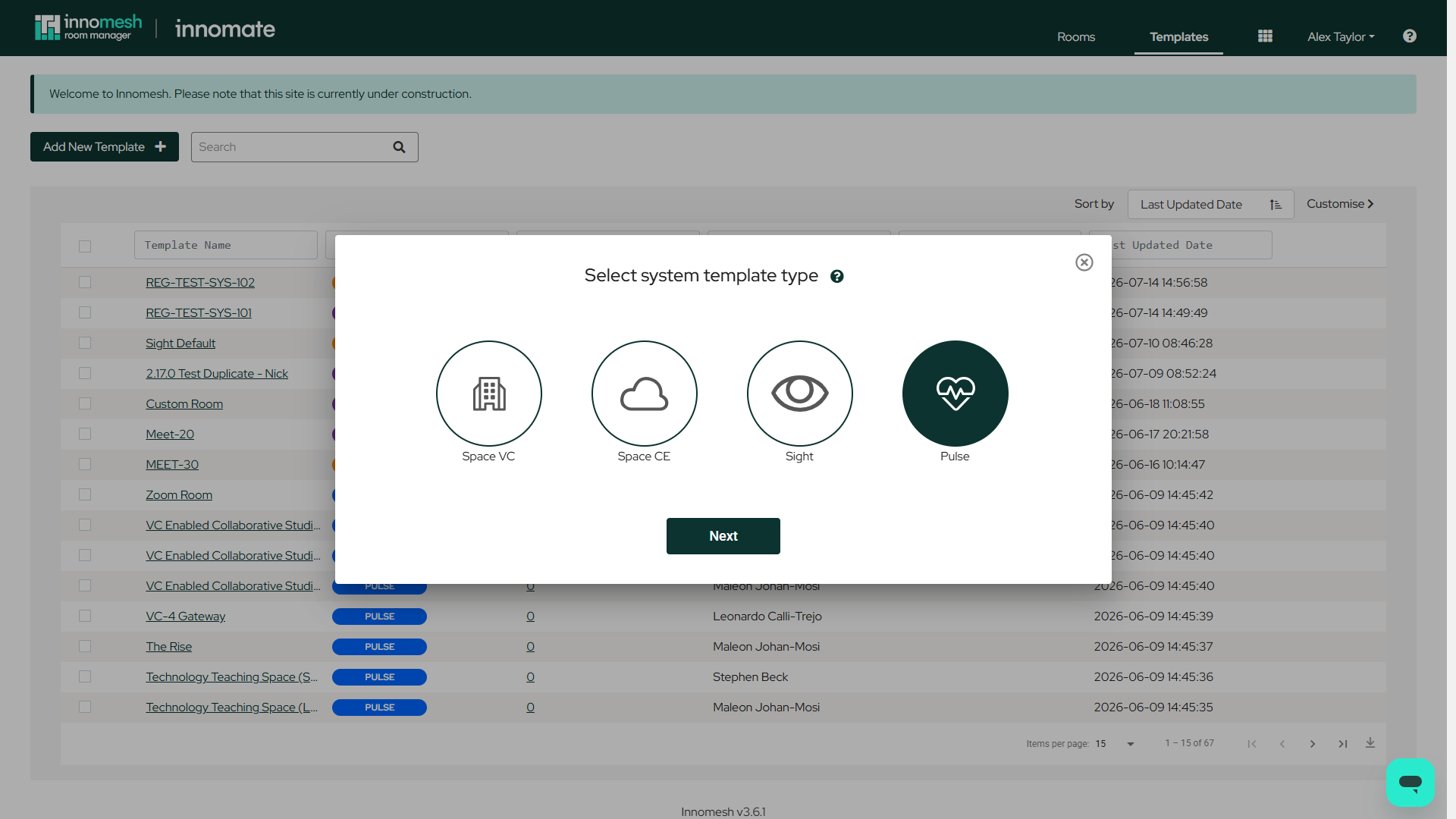 Selecting the Pulse template type | Innomesh Room Manager
Step 3: Enter Template Details
The main template creation view contains the following fields:
- Template Name: A friendly name to identify the template.
- Template Description: A brief description of the template’s purpose and the type of room it represents.
- System Type: The category of the room, such as Meeting Room, Conference Room, or Teaching Space.
Below the template details is the device list, where each device appears with its name, brand, model, and IP address or hostname. Devices are grouped under two tabs:
- Monitoring: devices Pulse actively polls for reachability and health.
- Offline: devices recorded on the template but not currently monitored.
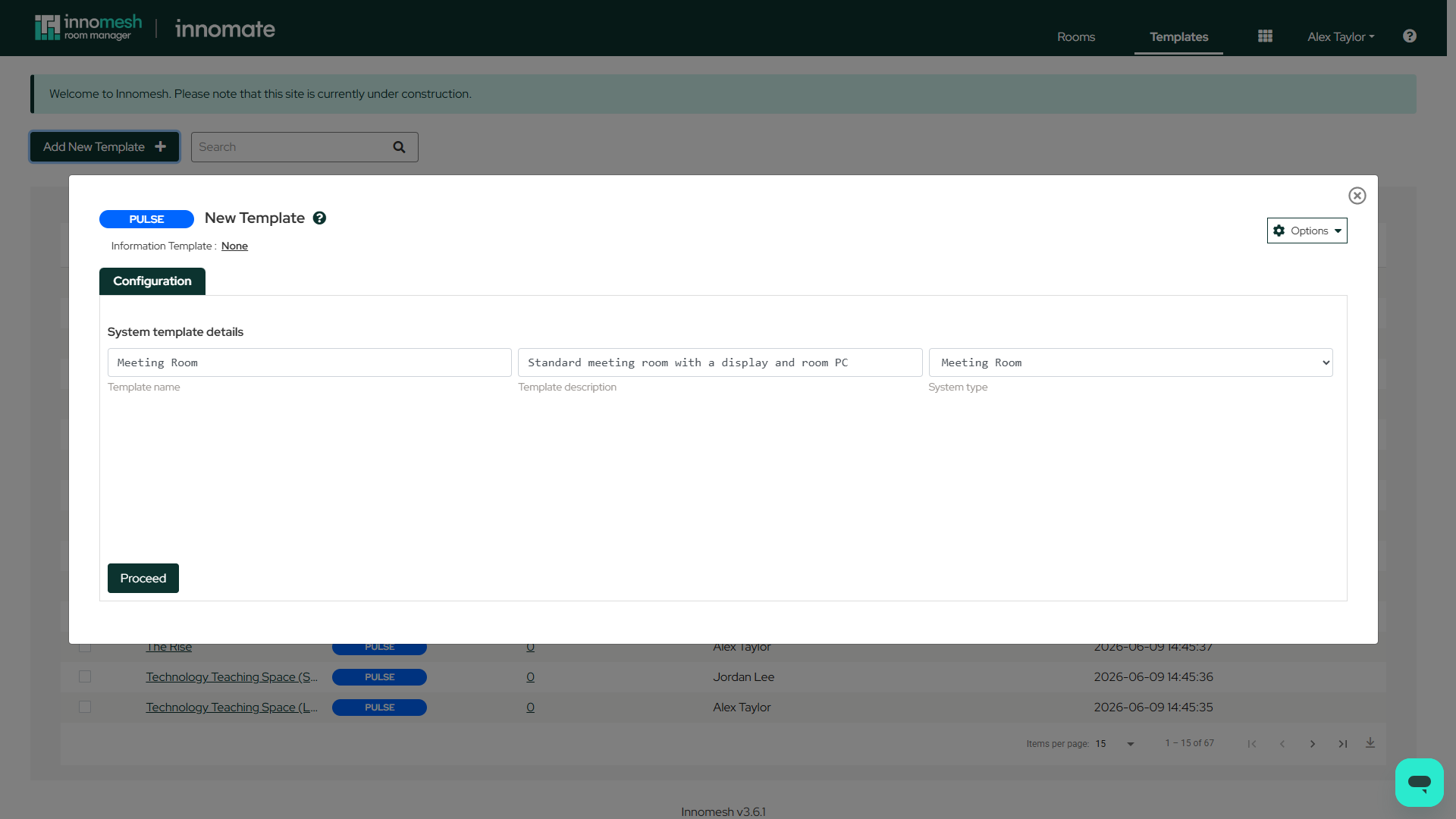 Pulse template configuration | Innomesh Room Manager
Step 4: Add Devices
Click the Add Device button to open the device configuration form. Search the list on the left and select the asset profile that matches the device you are adding.
Selecting an asset profile pre-populates the device’s core details, so you don’t enter them manually:
- Pulse driver used to monitor the device.
- Device ID (a unique identifier).
- Device Name.
- Manufacturer and Model.
If no asset profile exists for a given product, submit a request through the form in the Innomate Support Portal to have one created, so the device is captured with complete, consistent asset data. As a temporary measure while the profile is being prepared, you can choose a Generic device profile, which lets you set the Pulse driver (ICMP, TCP, or HTTP) manually.
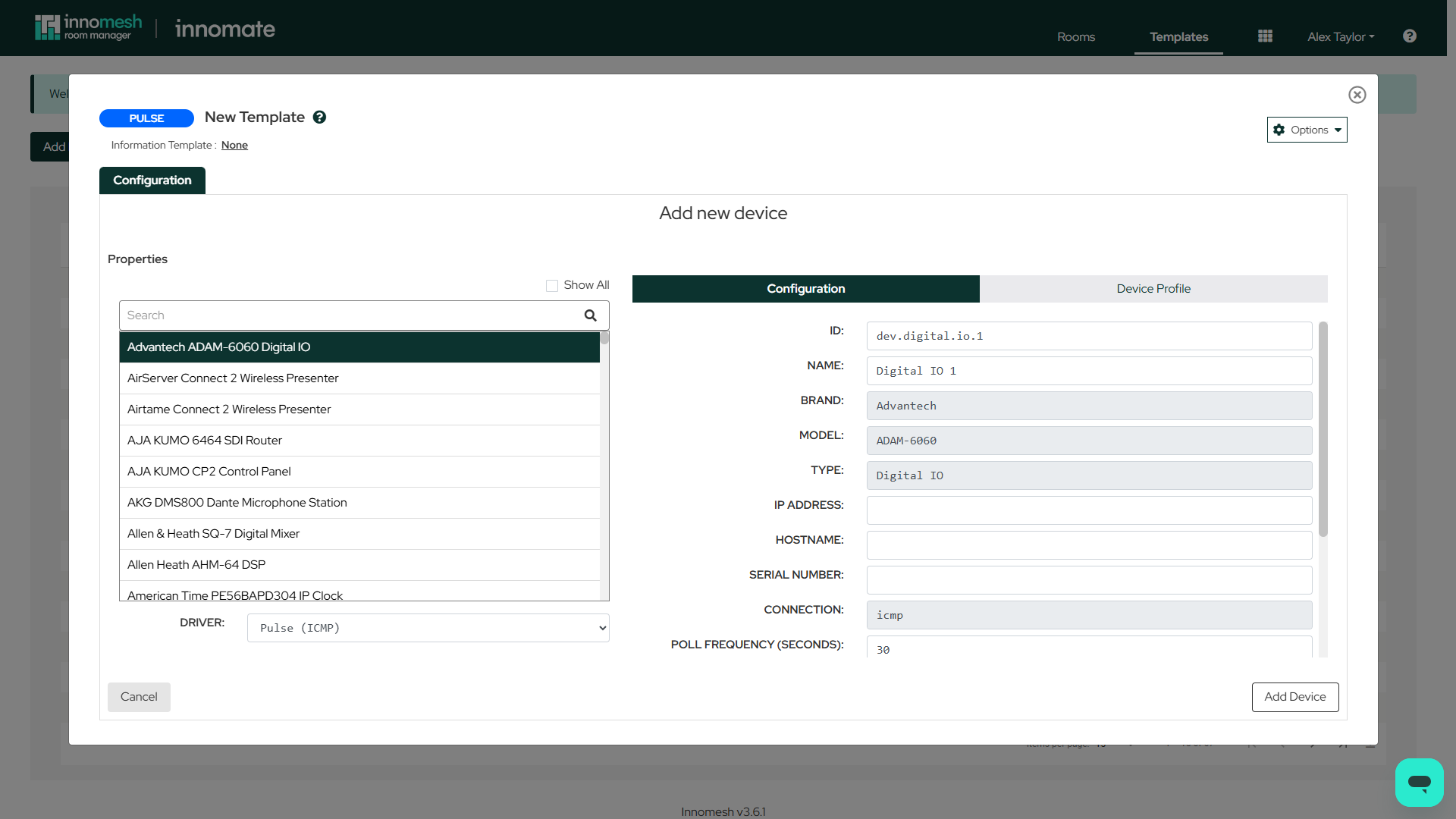 Adding a device to a Pulse template | Innomesh Room Manager
Filling in the Remaining Fields
With the core details pre-populated by the asset profile, complete the remaining fields. Which fields are required depends on the device’s Pulse driver. Pulse provides three driver types:
ICMP (ping): checks that the device is reachable on the network.
- Poll Frequency: how often the device is checked.
- IP Address or Hostname: the network address of the device.
TCP (port): checks that a specific TCP port is open.
- Poll Frequency: how often the device is checked.
- IP Address or Hostname: the network address of the device.
- IP Port: the TCP port to monitor.
HTTP (endpoint): checks that an HTTP endpoint responds.
- Poll Frequency: how often the device is checked.
- IP Address or Hostname: the network address of the device.
- IP Port: the HTTP port.
- Endpoint Path: the URL path to monitor.
- Username and Password: authentication credentials, if the endpoint requires them.
Additional Options
- In Maintenance: When checked, alerts for this device are diverted to the suppressed alerts list. Use this when a device is undergoing scheduled maintenance.
Repeat the Add Device process for each device in the template.
Step 5: Create the Template
Once all devices have been added, click the Create button to finalise and save the template.
Options Menu
The dropdown Options menu in the top-right corner provides the following utilities:
- Download as JSON: Export the template configuration as a
.jsonfile for backup or sharing. - Load Template from File: Import a template configuration from a previously exported
.jsonfile. - Copy Device IDs: Copy the template’s device IDs to the clipboard.
- Duplicate Template: Create a copy of the template as a starting point for a new one.
- Delete Template: Remove the template.